Offering Pre-Operative & Post-Operative Care
Cataract Surgery in Sharpstown
Don't Let Cataracts Cloud Your Vision
Over 50% of people aged 65 and older have a cataract in one or both eyes. As the cataract progresses, vision deteriorates, leading to a decreased quality of life. Fortunately, cataract surgery can easily treat this condition.

What Are Cataracts?
Cataracts are cloudy patches that develop on the lens of your eye. Cataracts can cause blurred or double vision, may increase light sensitivity and interfere with driving, especially at night. Without cataract surgery, millions of people around the world would be unable to see clearly.
The most common symptoms include:
- Blurred or double vision
- Trouble seeing at night
- Sensitivity to glare
- Colored halos around lights
- Colors appearing more faded
- Requiring brighter light for reading
When to Get Cataract Surgery
As we evaluate your eye health and vision, we'll carefully examine your lens for signs of cataract formation. If a cataract is detected and the clouding is causing visual disruption, our optometrist will refer you to a trusted surgeon for cataract surgery. Lifetime Eyecare & Contact Lens Center will be there for you, providing pre and post cataract surgery care.
As the condition begins to seriously impair your vision and adversely affects your daily life, impacting your ability to read, drive, watch TV or recognize faces, you should seriously consider surgery.

Benefits of Cataract Surgery
-
High success rate
Cataract surgery, one of the world's most commonly performed surgeries, has a 95% success rate.
-
Quick and convenient
This procedure can take just 30 to 45 minutes in an outpatient setting or hospital.
-
Prevents other eye problems
Removing cataracts can reduce the risk of eye inflammation and pressure inside the eye–a leading cause of glaucoma.
-
Rapid recovery time
Patients start seeing more clearly within a few days. Colors may seem brighter thanks to the new, clear lens.
How to Prepare for Cataract Surgery
- Apply antibiotic or anti-inflammatory eyedrops a few days before surgery if instructed to by your eye doctor
- Arrange for a ride after the surgery, since you won't be able to drive
- Wash your face in the morning of the procedure and don't wear eye makeup, strong perfumes or aftershave
What Happens During Cataract Surgery
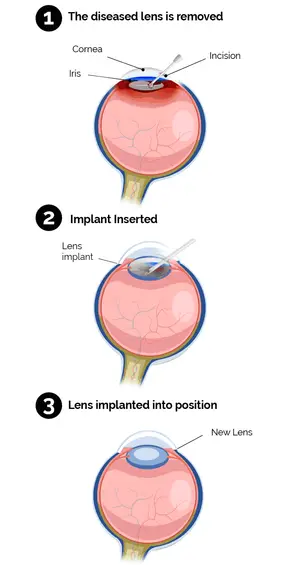
Cataract surgery removes your natural cloudy lens and replaces it with an artificial intraocular lens (IOL) to improve and restore vision. This common and very safe procedure is performed by an eye doctor (ophthalmologist) on an outpatient basis.
- The eye surgeon (ophthalmologist) will perform cataract surgery on one eye at a time. That means that you will come in for another surgery on the second eye. The procedure is brief and typically takes 30 to 45 minutes to complete.
- The eye doctor will place drops into your eyes to numb them and dilate your pupils. Though you'll be conscious during the procedure, you may be offered a sedative to help you remain calm. The eye surgeon will then remove your natural lens and replace it with the IOL. You should feel no pain or discomfort thanks to the anesthetic.

Cataract Surgery After-Care
After surgery, you may feel a bit drowsy as an after-effect of the sedative. Your eye doctor will prescribe eye drops to prevent infection, inflammation and to reduce pressure within your eye. The surgeon may recommend that you wear an eye patch for a few days after your surgery and the protective shield when you sleep during the recovery period. Make sure to avoid rubbing your eyes or touching them unless necessary.
A day after cataract surgery, we'll provide a post-operative eye exam to make sure that all is well. Your Sharpstown optometrist will further perform a series of follow-up exams in the weeks and months to come. If determined that you require corrective lenses following your cataract surgery, we'll make sure you get the proper prescription.
Cataract Surgery Management FAQs
While side effects are rare, there are some issues that people commonly encounter in the days after surgery, as the eyes heal.
- Dry eye
- Feeling that something is in the eye
- Blurry vision
- Light sensitivity
If any of these side effects do not subside within a week or two, please contact Lifetime Eyecare & Contact Lens Center.
You can delay cataract surgery, but keep in mind that your vision will likely worsen the longer you put off the procedure.
Cataract patients who also have age-related macular degeneration or retinal detachment may not respond well to cataract surgery and the new lens may not correct vision.
If you had great vision before developing cataracts, it's likely that cataract surgery will restore your sight. Moreover, the IOL inserted into your eye can be designed to correct refractive errors, providing you with clear vision.
Meet our Eye Doctors

Allen H. Chin O.D.
Language: English
- Accepting New Patients
- Family Friendly
- In Person Appointments
Allen H. Chin (“Dr. Chin”), O.D. received his Doctor of Optometry from the University of Houston’s College of Optometry in 1975. His undergraduate studies were completed at Louisiana State University (LSU) and the…

Allen J. Chin O.D.
Language: English
- Accepting New Patients
- Family Friendly
- In Person Appointments
Allen J. Chin (“Dr. Allen”), O.D. received his Doctor of Optometry from the Nova Southeastern University College of Optometry in 2003. He earned his Bachelor of Arts in Biology from the University of Texas at Austin.…
Patient Reviews
4.8
301 Reviews
Sunil K.- Sep 29, 2026
Doctor Chin Sr. and staff are excellent.
Michael N.- Aug 22, 2026
Always great service.
Your Cataract Surgery Co-Management Doctor in Sharpstown
-responsive.webp)
Hours Show More
- Monday 8:00 am - 6:00 pm
- Tuesday 8:00 am - 6:00 pm
- Wednesday 8:00 am - 5:00 pm
- Thursday 8:00 am - 6:00 pm
- Friday 8:00 am - 6:00 pm
- Saturday 8:00 am - 12:00 pm
- Sunday Closed
Insurance Plans Show More
- VSP
- Medicare
- United Healthcare
- Cigna
- Spectera
- EyeMed
- National Vision Administration (NVA)
- Aetna
- Versant Health
- Medicare Part B
- BCBS Federal Employee Program
Want to see clearly again?
Contact us today for pre-operative and post-operative care